
 特征值计算算法(含matlab demo)
1、幂迭代
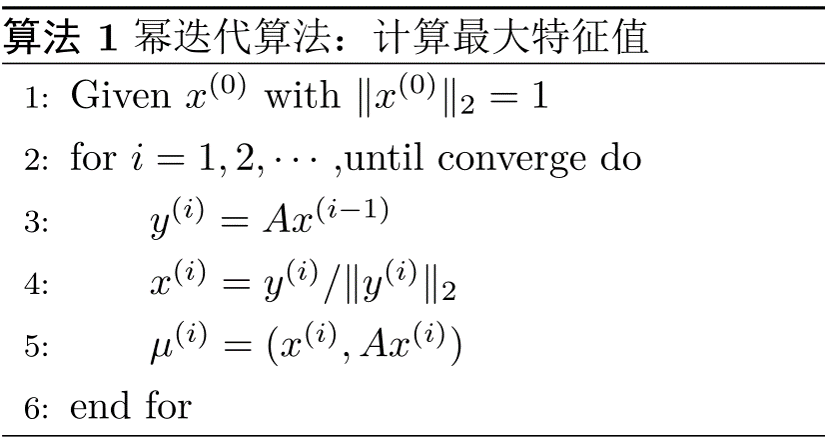
%%%%%%%%%%%%%%%%%%
% Power Iteration
%%%%%%%%%%%%%%%%%%

A=[ 11.2  12.6    1.0  -13.7
    4.3    6.6    1.5   -6.4
    8.3   17.5    4.5  -17.6
    6.1    3.0    1.7   -4.3 ];

% First step:Generate an Unit matrix
[m,n] = size(A);
x = rand(1,n);
x = x / norm(x);
x = x';

% Set Iteration
tol = 1e-6;
res_1 = 0;
res_2 = inf;
num = 0;
while(abs(res_2 - res_1) > tol)
    num = num + 1;
    y = A*x;
    x = y/norm(y);
    u = dot(x, A*x);
    res_1 = res_2;
    res_2 = u;
end
x,u,num
2、反迭代
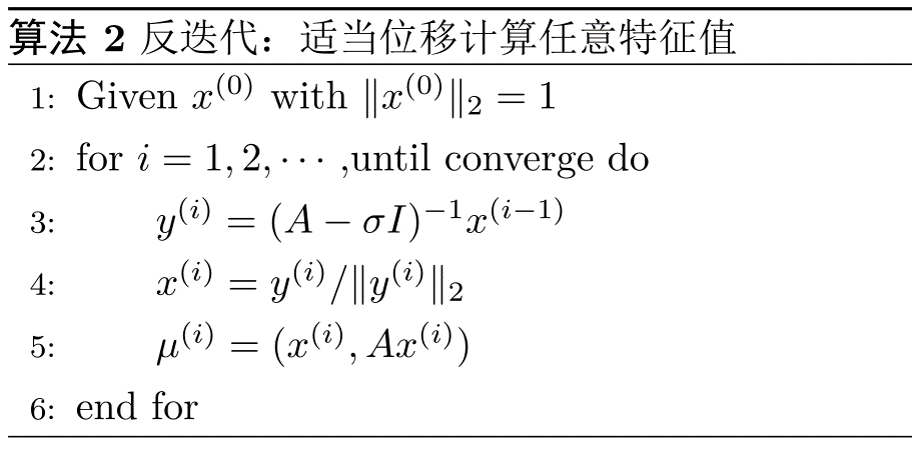
%%%%%%%%%%%%%%%%%%
% Power Iteration
%%%%%%%%%%%%%%%%%%

A=[ 11.2  12.6    1.0  -13.7
    4.3    6.6    1.5   -6.4
    8.3   17.5    4.5  -17.6
    6.1    3.0    1.7   -4.3 ];

% First step:Generate an Unit matrix
[m,n] = size(A);
x = rand(1,n);
x = x / norm(x);
x = x';

% Set Iteration
tol = 1e-6;
res_1 = 0;
res_2 = inf;
num = 0;
while(abs(res_2 - res_1) > tol)
    num = num + 1;
    y = (A-2*eye(4))*x;
    x = y/norm(y);
    u = dot(x, A*x);
    res_1 = res_2;
    res_2 = u;
end
x,u,num
3、Rayleigh商迭代
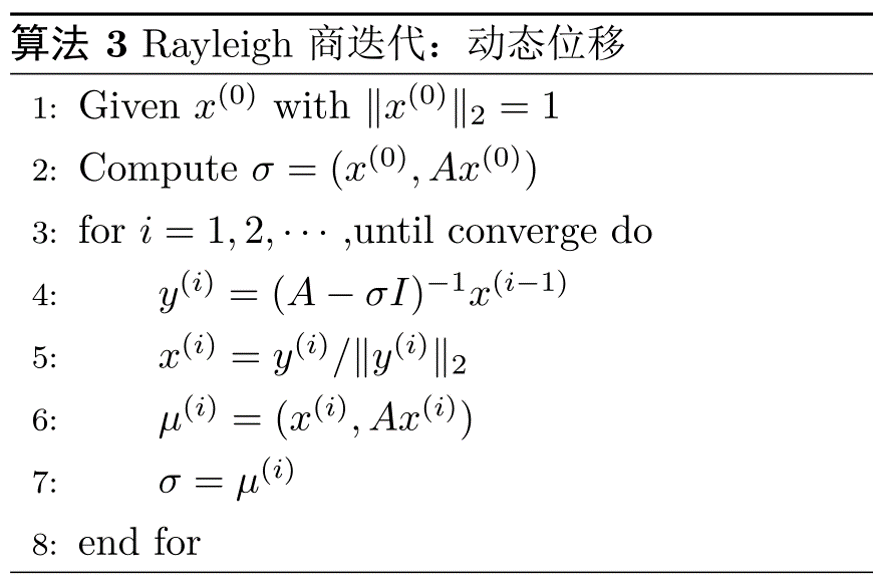
%%%%%%%%%%%%%%%%%%
% Power Iteration
%%%%%%%%%%%%%%%%%%

A=[ 11.2  12.6    1.0  -13.7
    4.3    6.6    1.5   -6.4
    8.3   17.5    4.5  -17.6
    6.1    3.0    1.7   -4.3 ];

% First step:Generate an Unit matrix
[m,n] = size(A);
x = rand(1,n);
x = x / norm(x);
x = x';

% Set Iteration
tol = 1e-6;
res_1 = 0;
res_2 = inf;
sigma = x'*(A*x);
num = 0;
while(abs(res_2 - res_1) > tol)
    num = num + 1;
    y = (A-sigma*eye(4,4))^-1*x;
    x = y/norm(y);
    u = dot(x, A*x);
    sigma = u;
    res_1 = res_2;
    res_2 = u;
end
x,u,num
4、正交迭代
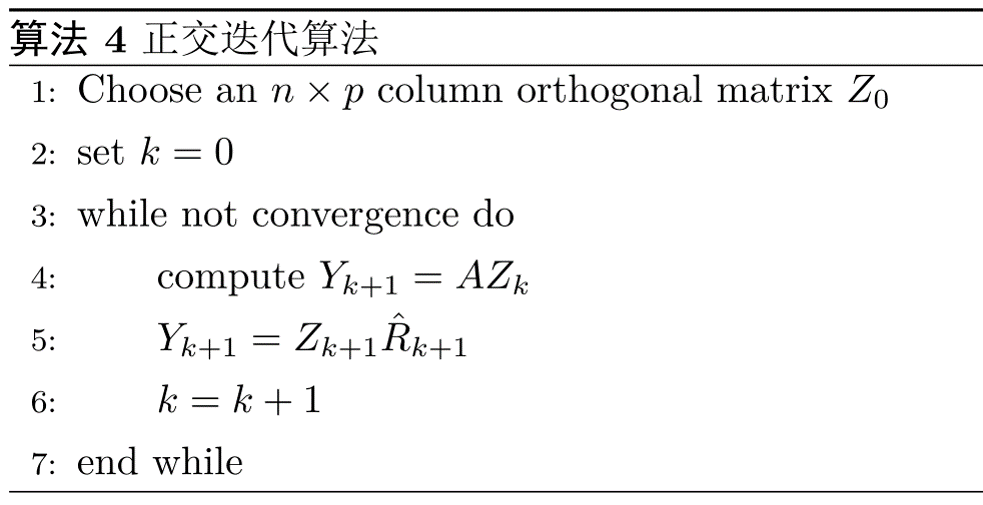
%%%%%%%%%%%%%%%%%%
% Orthogonal Iteration
%%%%%%%%%%%%%%%%%%

A=[ 11.2  12.6    1.0  -13.7
    4.3    6.6    1.5   -6.4
    8.3   17.5    4.5  -17.6
    6.1    3.0    1.7   -4.3 ];

% First step:Generate an Unit matrix
[m,n] = size(A);
Z = eye(4);
for k = 1:100
    Y = A*Z;
    [Q,R] = qr(Y);
    Z = Q;
end
R
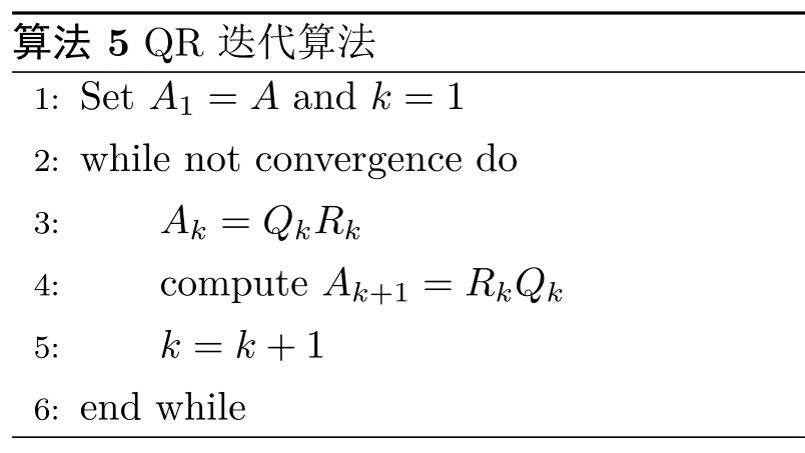
5、QR迭代
%%%%%%%%%%%%%%%%%%
% QR Iteration
%%%%%%%%%%%%%%%%%%

A=[ 11.2  12.6    1.0  -13.7
    4.3    6.6    1.5   -6.4
    8.3   17.5    4.5  -17.6
    6.1    3.0    1.7   -4.3 ];

for k = 1:100
    [Q,R] = qr(A);
    A = R*Q;
end
A